Thursday, December 26, 2024

Film review: The Holdovers (2023)

There's something of a vogue these days in making your film look like it was made in the 70s (looking at you, Joker - of course that film was made in the 70s and it was called Taxi Driver (with a dash of King of Comedy) - but I digress), but I cannot imagine any new films being as successful in this regard as this one, whose beginning, with very basic period-specific versions of the "a ____ Film" bits that begin every film, along with the crackle and flicker of real film going through a projector, instantly put me in the drafty confines of the Wellesley Cinema (I half expected a Pearl and Dean announcement).  The mood continues into the film, with drab muted colors (the wintry setting helps) and a sparse, 1970-specific soundtrack.  If it had been announced that this was a lost Hal Ashby film I would have believed it instantly, as it has a definite Harold and Maude (yes, there's a Cat Stevens song on the soundtrack)/The Last Detail vibe (and as you can see, they've even made the poster look period-authentic).  Indeed, the film is set in late 1970, specifically the Christmas break at Barton Academy, a posh New England boys' school.  Paul Giamatti (with a distracting fake wall-eye) 


plays an initially very Wilt-like Paul Hunham, who attempts to teach the little (although many of them tower over him) Visigoths classical history and is generally reviled for his savage grading and somewhat pungent odor.  We first see him in his little suite of rooms tut-tutting as he covers their finals with red ink, puffs away on his pipe and imbibes some strong liquor.  His reverie is interrupted, to his annoyance, by a very friendly lady, Miss Crane, 


dropping off some Xmas cookies.  Next we see him returning those finals (with grades ranging from F and F+ to the dizzy heights of B+) to his class of entitled teenagers on the last day of class.  


After a chorus of dismay at how these grades will bring their parents' wrath down on their heads, he offers them the concession of a post-break makeup final, but it must be on new material (on the Peloponnesian War).  In between these two Hunham events, we are introduced to some of his students in their dorms: the oikish and punchable Teddy Kountze and the gangly standoffish loner Angus Tully (the recipient of the B+).  Tully is looking forward to vacationing in St. Kitts, to Kountze's clear annoyance, as he is to be one of the very few "holdovers," who has to stay at the school over the break.  And watching over them, despite it not really being his turn (the teacher whose turn it is is getting out of it by claiming his mother has Lupus, which deceives exactly nobody, but Hunham wouldn't be leaving the school anyway...) is Hunham.  And we see him explaining to four glum faces (Kountze, the school quarterback, whose father is a helicopter magnate, and is being required to stay rather than go skiing because he refuses to cut his hair as per that father's demands, 


and two younger children, both Mormon, one Korean).  Cut to Tully, waiting outside the school for his parents to show up, when he is called inside for a phone call.  Because, of course (his face being on the poster), he is not going home.  His mother's excuse is that she hasn't had a proper honeymoon with her new husband and this is to be their time.  Tully is understandably distraught, and reminds her that he also wanted to take a detour via Boston, for reasons that only become clear much later in the film.  Anyway, the next fifteen minutes or so of the film involves some badinage among the three older boys and the two younger (where we see the sympathetic side of Tully as he comforts the Korean boy after an "accident" in his bed, and more boorishness from Kountze, who is racist and a bully to add to his sins) (memorable moment: Tully waxing lyrical to the white Mormon kid after Kountze throws one of his mittens in the river that the worst part is that the other one has been orphaned) until, one day as all are "studying" (Tully surreptitiously looking at a porn mag) a helicopter flies overhead, and the quarterback delightedly exclaims that he knew his father would cave, as he's a softy.  (There's a nice callback at the end of the film, the next time we see him in passing he has cropped hair.)  The quarterback is an amiable doofus and offers a ski holiday to everybody, which they are happy to accept, except... Hunham can't get through to Tully's parents.  So, lacking permission, both of them (and our third main character, the school cook and single mother to the most recent graduate to die in the service of his country, Mary (Da'Vine Joy Randolph, 


whom I knew as the irascible detective in Only Murders in the Building)) are still stranded, and Tully is twice let down by his parents.  Well, his mother and step-father, because his father, he blurts out in an argument with Hunham shortly afterwards, is dead.  And thus the real film begins.  And what makes this film so satisfying is that the three characters evolve organically: there is no sudden Scrooge-like conversion, where one character's view of another undergoes a 180 degree switch: all of them are wounded individuals who have no especial animus for the others, but just have to break out of their own wallowing to enjoy what the others have to offer.  Incidents include: a shoulder-dislocation, leading to some inspired lying, a visit to a local bar (and a discovery about Miss Crane), a disastrous (for some, exciting for one) party, a Christmas meal, 


and, taking up a sizable chunk of the last third of the film, a road trip to Boston (and Roxbury, for Mary), with bowling, ice-skating,


bookshopping (and prostitute rebuffing - with a memorable use of "candy cane"), 


bringing revelations galore, about Tully's father and Hunham's past.  But then, just when you think everything's rolling to a gentle conclusion, with school back in session, there's a final kink in the road that is handled in a way that is bracingly non-saccharine (and a memorable use of the phrase "penis cancer").  All in all, a wonderful little film, with a superb script, a character in Hunham that many an educator will find much with which (painfully) to identify and that is beautifully brought to life by the never-better Paul Giamatti.  (And the other two principles don't put a foot wrong, either.)  As Jami said, however, she didn't need to see it again, and I'm inclined to agree, at least for a few years.  Some things are a little too close to the bone.  Even if I don't have a box full of copies of Marcus Aurelius's Confessions to hand out as gifts.

Wednesday, December 25, 2024

Xmas


Film review: Christmas in Connecticut (1945)

 Last year the Barbara Stanwyck Christmas film was Remember the Night, an excellent movie but with a little bittersweet ending.  This year's offering is far fluffier, a very tasty Christmas trifle.  Having said that, it begins with an American destroyer being sunk by a U-Boat and two survivors left to float in a lifeboat for many days.  They are our main actor, the genial but slightly anonymous Dennis Morgan, playing Jefferson "Jeffy" Jones and his older, coarser buddy Sinkewicz.  They pass the time dreaming of food, but when they are finally rescued and taken to recuperate in a hospital, Jeffy is peeved to note that while Sinkewicz is getting steak, he's getting fed various variants on gruel, doctor's orders.  He buttonholes Sinkewicz about how he's getting the good stuff and he explains that it's "the magoo."  This turns out to mean that you've got to get your nurse to fall in love with you and she'll give you whatever you want.  So, with a few reservations, Jeffy tries it and gets both all the food he wants and an engagement (with a rather ditsy Southern nurse called Mary Lee) he doesn't.  


But Mary Lee is not convinced he's committed, because he keeps talking about being an artist and footloose and fancy free.  She decides the problem is that he's never had experience of real domestic bliss and comes up with a (frankly ludicrous) solution: she will write to the publisher of the magazines she's been reading to Jeffy and get him to get Jeffy to stay with the writer of the articles Elizabeth Lane in the domestic bliss she describes at her farm in Connecticut.  Of course Elizabeth Lane is Barbara Stanwyck, and she doesn't really live in a farm in Connecticut, she lives in a New York apartment.  However, the publisher Alexander Yardley (Sidney Greenstreet, playing a rare non-evil-schemer part) doesn't know this (and in fact insists that all his publications tell the truth, although one gathers that circulation is his main goal) and is very taken with the idea.  He calls Elizabeth's editor, tells him that Elizabeth will be required to host this war hero over Christmas and feed him up with her delicious hand-cooked food and introduce him to her husband and 8-month-old.  The editor shows up at Elizabeth's apartment in a tizzy, because he realizes that his job is on the line just as much as hers.  Also arriving is John Sloan, a rather pompous architect who is besotted with Elizabeth and keeps asking her to marry him, despite her insistence that she doesn't love him.  


Anyway, the editor suggests that Elizabeth tell Yardley that her infant has whooping cough and they can't risk the health of the newly-out-of-hospital war hero.  However Yardley is completely unfazed - he has grandchildren and knows that adults can't get whooping cough, and completely talks over Elizabeth at their meeting and even decides that he will show up as well, as his own family is too busy for him.  The editor, John Sloan and Elizabeth all gather at Elizabeth's favorite restaurant (run by her older Hungarian friend Felix, who dotes on her (we have already seen him bringing her a mushroom omelet for breakfast in her apartment) whose recipes are the ones she passes off as her own in her column to commiserate.  


John Sloan is actually pleased that Elizabeth will lose her job because then she'll be forced to marry him.  Then the editor hits on a genius idea: Elizabeth got the idea for "her" farm in Connecticut from the fact that Sloan has one, so if Elizabeth quickly agrees to marry Sloan they can use his farm, and disaster will be averted.  Oh, and Felix has to come along and do the cooking because in reality Elizabeth can't cook at all.

So that's the setup.  The farm comes with an Irish cook called Norah, played by the annoyingly screechy Una O'Connor (thankfully dialing it down a little in this film) with whom Felix butts heads, 


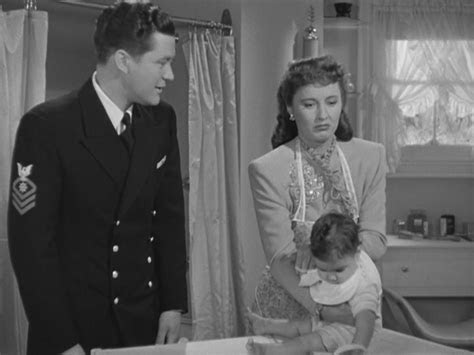
and the time at the farm is a series of farcical events.  As a stand-in for the non-existent baby is first a brunette female baby and then a blond male one (who talks, while the other doesn't - something that baffles and perplexes Yardley) belonging to local women who are working in a factory for the war effort and have been leaving them with Norah.  Elizabeth is useless at baby care as well, but thankfully Jeffy is an enthusiastic baby bather and diaper-er, thanks to being a loving uncle, so Elizabeth takes advantage of his offers of help.  


And, of course, falls hopelessly in love with him (and he with her).  There's some slightly scandalous banter when Elizabeth flirts shamelessly with him ("have you ever kissed someone married before") and meanwhile Sloan keeps trying to set up the marriage with the local judge, while Felix, who regards Sloan as far beneath Elizabeth (whom he calls "Lishka" - inspiring Jeffy to do the same) keeps sabotaging these attempts.  It all comes to a head when a local group invite the war hero and the publisher to a village dance to sell war bonds and Jeffy and Lishka dance out of the hall and into somebody else's horse-drawn sleigh, while the suspicious Yardley stalks them, and then, having lost them, he returns to spot a strange woman running off with the baby (who is, of course, her own) and calls in the police (who are currently arresting Jeffy and Lishka for theft of the sleigh).  


And then Mary Lee shows up!  What a shenanigans.  Apparently it is both criticized by conservatives for portraying lying as something that leads to happiness, and excoriated by progressives for its portrayal of domestic service as the ideal post-war role for women.  Both seem to miss the point, it seems to me, especially as Elizabeth not only keeps her job, she gets a big fat raise, and also she can't cook whereas a man (Felix) can, and happiness is only truly achieved when all the truth comes out.  If anything, there are a couple of scenes that are pleasantly progressive - while there are only two black people in the movie (neither in rural Connecticut, perhaps forgivably) they are both rather modern: a female package deliverer, 


and a cook in Felix's restaurant to whom he turns for the definition of "catastrophe" and gets a very learned etymology.  So I dub it harmless fun.  I definitely LOLed a couple of times.  A very satisfying Xmas film.

Tuesday, December 24, 2024

Pear Cocoa-Nibs?

 The last Bonne Maman advent calendar offering is not the most appetizing-sounding.

However, look what arrived in the post just in time:


Monday, December 23, 2024

Apricot Orange Blossom


Sunday, December 22, 2024

Beginning to look a lot like Xmas...

Definitely parky!


Today's flavor, "Mirabelle Plum-Linden Blossom"!?

Shortest day

Friday, December 20, 2024

Last day at the hospital?

Last night was much better sleep-wise, and we woke up to this:

They've found some kind of sedative that works like a charm on Frederick, so that definitely helps.  Jami came in to relieve me so I could go home and shower and breakfast.  Here's what the lobby looks like - here's hoping we won't actually be here for Xmas:

Frederick definitely feeling more chipper:

And here's the Bonne Maman advent spread of the day:

Hoping we can get Frederick home before the day is out, although, as Jami put it, nobody's said the word "discharge" yet (which has both pros and cons if you think about it).

UPDATE: discharged!  Phew!