
Sunday, December 26, 2021
New policy: selfie of the day

Saturday, December 25, 2021
Another Franklin Avenue Xmas
Time to settle down in front of a cozy fire (actually, it was too hot for a fire really (45°F) , but ...tradition) for a select gathering.
 Thomas is ignoring all HIS presents to focus on the Thompson family history compiled by sisters three Jane, Sally and Dinah. He was totally absorbed by it.
 Thomas was under the weather anyway, but after Grandma's diarrhea story (please please don't ask)...
 Before the maelstrom...

Friday, December 24, 2021
Film review: Sneakers (1992)
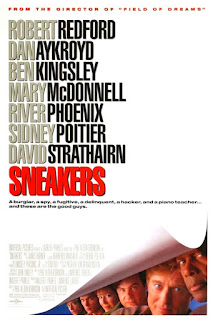
In one of the late seventies Doonesbury strips, one of the characters laments that there has been nothing distinctive about the seventies except 50s revivalism (presumably referring to things like American Graffiti and Happy Days). Flash forward to the 90s and it turned out that there was enough distinctive about the seventies for the 90s to be a seventies-revival decade. We had new Columbo and Rockford Files episodes! And we had this, which is a 1992 film that feels an awful lot like the films Redford used to make in the 70s. Specifically, it's a lot like The Hot Rock, less like more serious fare like Three Days of the Condor, because it's largely comedic, except where Ben Kingsley comes in somewhere after halfway through to be the Big Bad, and he's silkily sinister (except that his American accent is decidedly dodgy and he looks silly when he runs). Basically, Jami was in the mood for a heist movie and this was one of the few ones that we hadn't seen that came up on one of those lists. It actually begins in 1969 with two proto-hackers using a phone to hack into bank accounts and donate money from people like Richard Nixon to organizations like the Black Panthers, when they get peckish and one of them (who will grow up to be Ben Kingsley) palms a coin to ensure that it is the other ("Young Robert Redford") who goes out for pizza. He's in his snow-covered VW Bus trying to start it when the feds come charging in and drag the other one off to prison, where he "dies". Meanwhile young Martin Cline (or something like that) becomes Marty Bishop and is next seen breaking into a bank with the help of his crack crew of Sidney Poitier (ex-CIA "Crease"), Dan Aykroyd (very "Lone Gunmen" esque as conspiracy theory-obsessed "Mother"), the electronics guy, Blind "Whistler" (David Strathairn, who would later come to prominence in the Redford-directed Quiz Show), whose hyper-sensitive hearing drives many a plot-point in this film, and the youngster Carl (River Phoenix, who would of course die the following year outside Johnny Depp's nightclub).

It turns out that they're not really robbing it - they're proving that it can be robbed, which is their job as a security consultant firm, which doesn't pay nearly so well. The next day, however, they are approached by two NSA agents who want Bishop and co. to steal a "black box" off a genius mathematician giving a visiting lecture at one of the local (it's San Francisco) universities. Bishop thinks it stinks, even though they explain that they can't do it because they're banned by act of congress, but they're driven by inter-agency rivalry (with the FBI and CIA), but just as he's walking out, one of them hands him his number and calls him by his real name (and the number is written on the back of his "Wanted" poster from back in the day). They promise to clean his file if he does it, but arrest him if he doesn't, so, naturally... And of course his buddies are all in (driven in part by the $170K they're offered - which, I must say, doesn't seem like much among the 5 of them, but I suppose inflation has changed things since the 90s). But he needs the help of a woman, he decides, and this is where his ex- played by Mary McDonnell (who has one of those faces that was popular in the early 90s - was she in China Beach? No, that's Dana Delaney. Northern Exposure? No, that's Janine Turner. No, she was in one of the TV Fargo serieses, and is probably known to most as the President in the respectable TV reboot of Battlestar Galactica).

Of course she doesn't want to be roped back in, but who can refuse Robert Redford, even middle-aged wrinkly Robert Redford? Getting the box turns out to be surprisingly easy, but at the party to celebrate their success, Whistler works out what it does - it decrypts anything. Turns out that's what the mathematician discovered, and he wired it in a chip. Well, it should be safe in the hands of the NSA, shouldn't it? But just as Marty has handed it over to the NSA guys, Crease (who is waiting in Marty's smart little orange Karman Ghia) spots a newspaper item about how the mathematician has been murdered, and he gets Marty out of there. Those guys were not NSA, and it turns out they were not the Russians either (yes, I know this is post-fall-of-the-Wall, and pre-Putin, but they go over that). So whom? Well, you've probably guessed. This leads up to the final heist of the film being retrieving the box so that the real NSA don't lock Bishop up. Shenanigans ensue.

Overall: pleasant and non-taxing. They didn't even make 'em like that any more in 1992.
Thursday, December 23, 2021
Film review: Robinson Crusoe on Mars (1964)

Say what you will about this film, but it announces what it is in the title and by God it sets out to deliver. Imagine The Martian, only with pre-Star Trek special effects and a batshit crazy subplot about aliens using other aliens as slaves in their mines and you've essentially got it. It starts off fairly realistically, with a ship orbiting Mars containing two astronauts (one of whom, distractingly, is Adam West, but our hero, Cmdr. Christopher "Kit" Draper, is a largely unknown actor called Paul Mantee) and a monkey (who's called Mona but is played by a male, so has to wear a fur diaper to hide the genitals).

There's an attempt to capture the zero-gravity effects that 2001 later did so well, and some banter about eating all their food out of squeeze tubes. Things are swiftly derailed, however, because they have to drop lower in orbit to avoid a meteor and are captured by Mars's gravity without the fuel to escape. So Draper ejects, to be followed by West's "Mac" McReady with Mona. Draper crash lands and his pod is swifty damaged by a fireball that comes out of nowhere. He finds that he can breathe the atmosphere but only briefly as it is too thin to sustain him. He sets out in his (slim and trim, as befits the 60s) spacesuit, with all the oxygen tanks and food tubes he can salvage, to find shelter.

He eventually finds a cave, and also works out that some yellow rocks can be burned like cheap coal, which is a good thing, because it gets very cold at night. (Of course, in reality, it's -100°C in the daytime on Mars, but our hero gets to swan around in a T-shirt later.) Then he sets off to find Mac. Good ol' Mac - he'll know what to do. Except, of course, that he's dead, with just his beringed hand sticking out from the rubble. After Kit has expended vital oxygen burying Mac,

he gets a fright - some strange furry snake-like thing is moving behind the wreckage of the capsule. Fortunately he's brought along his weapon, which, rather bizarrely, is a very old-fashioned long-barreled revolver, and he advances slowly on the strange alien creature... which of course turns out to be Mona, in an adorable little space suit. First thing Kit does, after claiming to be so glad to see her, is to steal her two tiny air tanks for himself! Fortunately, she seems to manage on the thin Martian air. However, once he gets back to his cave with Mona he has just about exhausted all the air even in the little tanks, and after letting Mona gorge herself on the food in the tubes, he collapses... only to wake up because air is bubbling up through the sand at the edge of his firepit. Turns out that burning the yellow rocks also gives off air. So now (at least once he's set up a system for syphoning the air and pumping into the canisters, along with an alarm that wakes him up every four hours so he can breath from the tank and not get hypoxia), he's solved two problems, heat and air, and has two left: water and food (once he hastily recaptures the tubes from Mona now they're going to live). Well, here's where Mona comes in useful, and the movie takes further steps from realism. However, there are nice, realistic touches. The landscape is gorgeous (filmed in Death Valley at its most alien), and the skies bright red. And his empty spaceship keeps passing overhead every time it orbits Mars, until it becomes too upsetting and he remotely triggers its auto-destruct. This in turn seems to trigger the real craziness that follows, complete with "alien" (he looks pretty damn human to me) escaped slave which he calls Friday,

and the very-similar-to-the-alien-ships-from-the-director's earlier War of the Worlds alien slave-owners' ships that bombard the planet with death rays, and seem to be tracking Friday by his bracelets.

They leave after a while (leaving all Friday's fellow slaves dead), and gradually Kit stops being such an asshole (he actually calls Friday "retarded" at one point) and realizes that Friday isn't a deaf mute, and that maybe he should learn some of Friday's language as well as forcing him to learn English. In fact, they're pretty pallsy by the time the bad aliens come back and really lay into the cave, whereupon they have to use the Canals of Mars (which by 1964 were well-known to be about as real as Piltdown Man) to escape to the polar icecap.
All in all: an odd mixture of 2001 and the worst Star Trek episode, and corny in a lot of places, but oddly beautiful, and strangely not boring, even though most of the film involves pottering too and fro from that one cave. Apparently it was supposed to feature a lot more alien life (and Mona was going to be a furry Martian armadillo), but budget precluded that, and perhaps that's for the best.
Wednesday, December 22, 2021
Film review: Family Plot (1976)

This is, of course, Hitchcock's last film, and I have to say it's a lot better than Torn Curtain. It reminds me a lot of an episode of the Rockford Files (70s, fairly jokey and low-stakes, set in and in the mountains outside of, Los Angeles) crossed with the 70s version of Freaky Friday, because of Barbara Harris, prepared, in both, to do plenty of physical comedy. Harris plays Blanche Tyler, who is a phony psychic, in a relationship with aspiring actor but current cab driver George Lumley (an uncharacteristically gentle and likeable Bruce Dern). That's one of the two couples in the film: the other is the quintessential 70s pairing of Karen Black

(seriously, check out how her career nosedives after the 70s) and William Devane (if you don't recognize the name, you'd recognize the face), who play a couple whose occupation is kidnapping, for which they demand incredible gems as payment. The first couple starts us off: Blanche persuades a rich old lady, "Julia Rainbird," that she is in contact with her sister Harriet on the other side, and Mrs. Rainbird vows to set right a 40-year-old wrong: giving up her sister's illegitimate child for adoption. She asks Blanche to use her psychic abilities to find this child so that he can be sole inheritor of the Rainbird fortune, for which Blanche will be paid $10,000. Blanche spills this info to George as he drives her back from the Rainbird mansion, insisting that her insight that Mrs. Rainbird's sleep was troubled (by nightmares of Harriet) to her contact "on the other side," "Henry," which disgusts George, who insists it was because of him grilling the local chemist and finding out Mrs. Rainbird kept badgering her for prescription sleep-aids. George, it turns out, has good investigating abilities, which is just as well, otherwise we wouldn't have much of a film. Anyway, as they bicker and exchange rather crude sexual innuendo (I think Hitch was trying to "get with the times" - this is a little cringeworthy, as is the casual use of "bitch" by both our male partners), a blonde woman crosses the road in front of the taxi, and buzzes to get into a building. This turns out to be a disguised Karen Black, silently coming to collect a gem and a helicopter to take a cop to pick up the sedated industrialist they have kidnapped. This goes off without a hitch and when they return to their little house (with its disguised soundproofed room, for the keeping of kidnappees), they hide the gem in their chandelier.

Now, what do these two couples have to do with each other? Well, it's not too much of a spoiler to reveal that William Devane's Arthur Adamson is, in fact, the missing child. (I must admit, I was a little surprised that Blanche and George actually tried to find the real one instead of George simply pretending to be him, so they could get the $10K and the Rainbird fortune, but apart from dubious psychic nonsense, they're actually decent folk.) The child was taken by a (now long dead) chauffeur and given to a childless couple who died, along with "their" child, in a house fire in 1950. However, George is suspicious because the stone for the parents is much older than that for "Eddie Shoebridge" their child.

He suspects that Eddie faked his death, and in fact, Eddie/Arthur actually trapped his parents, and (with the help of thuggish friend Joe Maloney (played by Ed Lauter,

who joins Arthur's jewelry store assistant Edith Atwater, as actors we have seen in actual Rockford Files episodes), who owns a gas station near the titular Family Plot) burned them to death! He's a real stinker (although his kidnapping methods are strangely humane - the victim gets knocked out with ketamine injections before and after their time in the secret room, but are fed homecooked meals complete with bottles of wine, and returned unhurt). The thuggish Maloney looks up Arthur in the city (not an uncommon occurrence, it seems, as Maloney likes to hit him up for cash occasionally, given what he knows about him) and alerts him to George's investigations, and then, oddly enough, George and the kidnapping couple cross paths, as George is coming to see a bishop who might know where the boy ended up, at the same time as the couple kidnaps him! This coincidence unsettles Arthur enough that he sets Maloney to bump off George and Blanche, which cues a brakeless descent of (presumably) a High Sierra or other, complete with the Barbara Harris physical comedy previously alluded to.

Anyway things come to a head just as George has to do some cabbing, lest he get fired, and Barbara tracks down Arthur (whose name has been revealed by Maloney's (spoiler) widow), just as they're about to exchange the bishop for another gem. Blanche ends up in the secret room, but fortunately she left a message for George saying where she was going. Arthur intends to fake Blanche's suicide, meanwhile Karen Black is getting cold feet...

All in all, a very pleasant diversion, leisurely paced (Hitch's last 5 or so films were all over two hours long) but never boring diversion. According to Bruce Dern, Al Pacino (who would have been totally unsuitable) was offered his role, but asked for a million, and Hitchcock (who pronounced Pacino as "Packinow") said "Hitch doesn't pay a million dollars." Certainly paying anyone a million for this light soufflé would have been over the top, even though everyone in it is very good. Oh, and Blanche finally convinces skeptic George of her "true" psychic abilities...
Monday, December 20, 2021
Film review: Blessed Event (1932)

A decent film poster for this doesn't seem to be available online. It's not really an obscure film, although it is Pre-Code, and the Criterion Channel print of it was pretty pristine. It's a fun little film that looked like it could be skirting more tragic elements but was determined to remain light and breezy throughout. The lead actor is one I've never seen before, but who apparently had a solid career - Lee Tracy.

He plays Alvin Roberts, someone who worked in advertising for the Daily Express but got to sub for the gossip columnist George Moxley (an excellently deadpan Ned Sparks) while he was on holiday and turned the column into a scandal sheet, revealing what society couples were about to procreate (using the code words "Blessed Event") by bribing a nurse in the maternity ward to tell him the minute rooms were booked. His moment of truth arrives when he reveals a "blessed event - without benefit of clergy" and it ruins the woman involved.

Brief recap: Al's salacious baby-gossip inflames the masses, brings in threats of lawsuits, but most importantly, massively improves the Express's circulation. So when Moxley comes home early from his vacation to deal with the clamor, the owner of the paper takes him aside

and puts him on various bogus assignments (ending up as the Pet editor) so that he can keep Al churning out the rumors. Al is soon sitting pretty, even more so when an attractive high schooler comes to interview him for her school's newspaper and he starts to court her (it cuts down the ick factor that she looks in her late 20s).

But then a well-known Chicago hit man comes up to warn him against some things he's said about his boss, and Al shows that he's canny and brave as well as a tabloid trash-monger. He records his confession to a recent hit on his newfangled dictation-taking device (it records on tubes of something breakable) and, having sent an intern downstairs with them, confront him with this fact and uses it to turn him from threat to stooge, as a plant in the city's underworld who will feed him tips to keep his bottom away from the electric chair that Al describes so vividly to break his spirit.
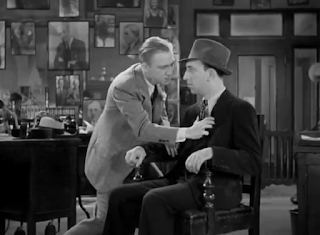
(After he leaves Al discovers that the boy tripped going downstairs and the recorded evidence is all broken, but thankfully the hitman never discovers this.) Threaded throughout is Al's long-running feud with local crooner Bunny Harmon (real name: Herman Bunn, played by Dick Powell in his first film role)

whose radio show his mother adores. This leads to a climax where Al sneaks into the opening of Harmon's new night club, to prove that he can, despite being banned, only to be shot at by a new hired goon of the mob boss (who, it turns out, is the baby-daddy of the singer who blabs her secret to Al, thinking he already knows it, gets his assurance that he won't reveal it, and is stabbed in the back, the one thing he feels bad about). Will Al's girl ditch him because of his dirty trick? Will Al survive the hit attempt? Will the poor singer commit suicide now her mother knows she got knocked up out of wedlock, or will the mob boss have her knocked off to keep the secret from his wife? It won't take you long to find out, this one's a trim hour and twenty minutes.
Saturday, December 11, 2021
Grandpa can relax now
Whenever Grandpa would come to visit in the Summertime, he would lie in the hammock gazing up at the huge dead branches on the tree overhanging the house (specifically Thomas's room) and worry. Well, today was really windy, and while I was (finally) moving some of the wood into the garage, I heard a massive crash and...
 Jami was supposed to be vacuuming up the leaves with the lawnmower (because it's been very mild - nearly 60 - but it's about to be very cold. But then it's going to be warm again - climate change, eh?) - just as well she was feeling lazy...
Wednesday, December 8, 2021
Film review: Torn Curtain (1966)
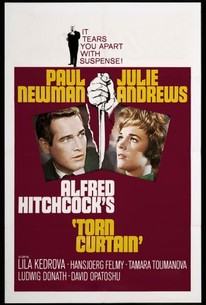
I said that with Lifeboat I had completed all the "major" Hitchcocks, and watching this certainly didn't give the lie to that claim. While it has a few sequences of note, nothing in it is first-tier, and you really feel the 2+ hour length. You can see that it's very similar in structure to North By Northwest, which can also seem a bit deliberately paced in places, but somehow nothing really jerks the picture into life. Not helping at all is Paul Newman, who just seems utterly miscast. He, like the picture, is curiously inert, and the contrast between him and Julie Andrews (with an uncharacteristic haircut), whose simple naturalism works nicely, but just bounces off the usually stone-faced Newman. Perhaps the problem is that his character is a bit of cipher. The basic idea is that Newman (Cary Grant would have done so much more with the role) is a physicist/engineer (the world's youngest and sexiest) who has been working on an anti-missile system (you know, to defuse the nuclear threat of the Cold War) but has hit something of a roadblock. But he knows that there's an East German boffin who's come up with the solution, because he's published a paper on it in some East German journal. So Newman's Michael Armstrong hatches the plan of pretending to defect while at a conference in Stockholm, to gain access to said boffin. Unfortunately, he can't tell anyone, not even Andrews' Sarah Sherman, who is his assistant and fiancée, who nonetheless manages to follow him onto the plane to East Berlin, despite his attempts to shed her. Naturally, he's given a hero's welcome

(because he has already alerted them, in particular the rather sympathetic character of Karl Manfred, who has been on the cruise leading up to the Stockholm conference). Then the rest of the picture is him trotting parts of East Germany, including Leipzig, where the boffin (Professor Gustav Lindt) is based, making contact with various allies and being chased by various suspicious Stasi types, first without Sarah, but then, after he's got what he's after off Lindt (in a tense scene of... writing on a blackboard), with Sarah. Key scenes are a chase through the abandoned Art Museum of East Berlin

(which Jami assures me is full of treasures looted by the Nazis), a fight at a farmhouse, where Michael and a farmer's wife have to kill Michael's follower in an agonizingly slow process that finally involves dragging him bodily over to a gas oven and sticking his head in there until he suffocates! (And then burying him and his motorbike!) and a ride aboard a fake bus from Leipzig back to East Berlin, where the real bus is getting closer, and will alert the cops to the fakery. Oh, and then the actress Lila Kedrova

nearly steals the movie when they're back in East Berlin trying to find a way to sneak out, as a Polish woman contemptuous of the East Germans who wants American sponsors. And, in a typically misogynistic Hitchcock touch, they are almost undone by the vain lead ballerina of a Czech ballet company who cannot forgive Michael for upstaging her when they exit the plane on arriving for the first time in East Berlin. Overall: eminently missable. And that's even with the scenes of Newman and Andrews cavorting in bed at the start, where Newman famously quipped to her about how this would ruin her Mary Poppins image.

Subscribe to:
Posts (Atom)
