Saturday, October 23, 2021

Film review: Heaven Knows, Mr. Allison (1957)

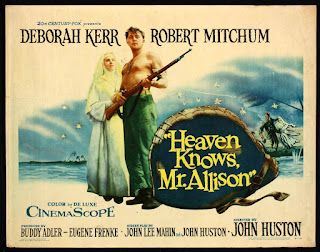
As this was in CinemaScope, I thought an extra-wide poster was appropriate.  This is the film John Huston directed right after The African Queen, and the general consensus seems to be that it was rather dismissed as being too similar, in the "rough-and-ready American Male rescues prissy female of higher intellectual class" vein.  Only this time, instead of Bogart and Katherine Hepburn, we have Robert Mitchum (unusually lovable!) and Deborah Kerr (in a lesser nun-playing role after Black Narcissus), and instead of Africa we have the war-torn South Pacific.  So in that respect, it has a lot in common with Father Goose, only Mitchum is as marooned as Kerr, having been a marine whose submarine was attacked just as he was getting out of it, and who washes ashore in a rubber dinghy.  And it's a good deal less of a comedy than Father Goose, despite the jokey-sounding title.  In fact, it would be fair to say that it's a rom-com without much of either, as Kerr's vocation is a pretty large barrier to the latter.  (Perhaps the biggest concession to the latter is an early scene when they still have Allison's boat and use it to chase a big sea turtle, who puts up a fight - see magazine clipping below for Kerr's sweary comment during the filming.)

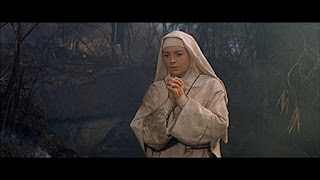
However, it would also be fair to say that it's surprisingly gripping, especially as the two leads are pretty much the only people on screen for the vast bulk of the film, apart from some Japanese-speaking Japanese soldiers, and a rescuing party of American Marines at the very end (spoiler).  And the film opens like a thriller, with Mitchum furtively exploring an apparently-deserted camp that might conceal hidden Japanese soldiers, having washed ashore in his escape-raft.  What he finds, of course, is Kerr, sweeping out the church which sits rather incongruously among the tropical foliage.  Turns out she's been there four days because she came with the septuagenarian Father Ryan to help rescue another Father, who had already left, only to have the nervous natives who ferried them there abandon them for fear of the encroaching Japanese.  Father Ryan didn't last two days, either, and is buried in a fresh grave, leaving behind only his pipe.  


Turns out Mitchum's Mr. Allison (we never learn his first name) is so-named because he was delivered as a baby to an orphanage on Allison Street in Milwaukee, whence he escaped to a life of crime at age 14, only to be rescued by the Marines.  He sees his commitment to the Marines as very similar to Sister Angela's devotion to the church.  Of course he falls for Kerr's Irish nun fairly quickly, although her nunnitude is played very seriously and her devotion clearly earnest, something that makes the film seem more grounded and earnest than you would expect.  Clearly Huston, who also wrote the script, had a great deal of respect for the Catholic faith, despite having Mr. Allison refer to believers in the Marines as "Mackerel snappers".  (Turns out Sister Angela is not, herself, a good Mackerel Snapper, as she cannot keep down the raw fish he feeds her, which in turn leads to an incredibly tense scene where he raids the stores of the Japanese camp currently on the island. He gets trapped overnight, and Sister Allison wakes up to find him not there and is convinced he's been shot.

(In the course of the film there are first, no Japanese, then the raft they are adapting to sail to Fiji gets bombed by the Japanese, who then land and form a camp, then the camp is deserted, then the Japanese come back.  It all makes sense, and this raid is in the first stay.)) (Having said that, apparently the National Legion of Decency monitored the production, and "knowing this, Kerr and Mitchum deliberately ad-libbed a scene (not included in the final print) in which their characters wildly kissed and grabbed at each other."  Good for them!)  


But in general, Mr. Allison is nothing but solicitous for Sister Angela, the one exception being when the Japanese desert their camp and the two of them move in and Allison gets drunk on a bottle of Sake they find hidden (seen earlier by Allison on his raid for supplies) and laments that she had to be so young and pretty, "with FRECKLES".  This turns into a speech about how they don't have to be loyal to the church and the Marines because the war has passed them by and they're like Adam and Eve (which would've been a better title than the misleadingly corny one they went with).  (At this point there has been a big sea battle in the distance and they don't know who won, but if it had been the Americans they would've landed by now.  The next day the Japanese return.)  When he's drunk, you get a glimpse of the scary Mitchum of Cape Fear or Night of the Hunter, and Sister Angela runs out in tears into a rainstorm.  This being Hollywood, this automatically leads to a dreadful fever, and the remorseful Allison has to drag her back to the cave they'd been hiding in when the Japanese were here the first time when they come back.  Only he has to do another raid on the camp for warm blankets (after he has to remove her from her wet clothes - something that is passed over off screen) and this one doesn't go off so well - he ends up having to stab someone to death, something that Sister Angela bitterly regrets when she hears about it, and not just because it causes the Japanese to scour the island.  In fact, they are about to be grenaded out of their cave when the Marines arrive.  


Allison has to do one last feat to ensure they can land safely before the film wraps up... very unsatisfactorily, if you're hoping for Hollywood ending.  But ambiguous enough that you can hope for a happily ever after.  Overall, not especially deep, but a very solid and absorbing little number, with genuine chemistry between the two leads, who are both at the top of their games.

Sunday, October 17, 2021

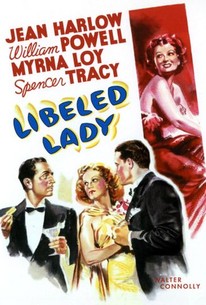
Film review: Libeled Lady (1936)

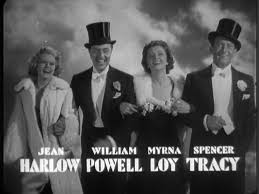
What a lineup!  


Here's the main idea: Spencer Tracy is newspaper man Warren Haggerty, who is about to wed his fiancee, Gladys, 


is called away (and relieved to be) to deal with a disaster, viz,  the paper has put a false rumor on the front page about Connie Allenbury (Myrna Loy), socialite daughter of millionaire James B. Allenbury (a very familiar-looking Walter Connolly), and before they can recall all the editions, the Allenburys get wind and Connie sues them for $5 million (in 1936!).  Warren's solution is to hunt down the paper's "libel man" - that is, the guy who gets people suing the paper to stop, through fair means or foul.  This is William Powell's Bill Chandler, and there's no love lost between him and Haggerty, who fired him.  (Turns out he's very fireable - since he left this paper he moved through papers all over the world, only to be traced to a hotel in New York.)  The plan is to be on the same boat as the Allenburys coming back from Europe and to charm Connie into his cabin for a cocktail, there to be photographed and countersued by Chandler's "wife" for estrangement (which would also undermine the libel suit because that's essentially what they'd accused her of in the false headline).  So, to set this up, Bill needs to be married, and Haggerty, heel that he is, nominates his fiancee.  She is none-too-pleased at this plan, especially as she's been married and divorced already, and wants to have a marriage that lasts.  But she goes along, and the two are married.  (The justice of the peace is outraged when the "bride" liplocks with the "best man" (Haggerty) and Chandler has to explain that he's an old friend of the family.) The couple has to make an appearance of connubial bliss by sharing a hotel suite, but Gladys insists on a locked door between them.  However, the next day Bill is off to Europe to set the plan in motion.  Thus begins the real meat of the film, which is the developing romance between Bill and Connie.  It gets off to a very rocky start (to Bill's surprise - he has a reputation as a ladykiller), although Bill does completely win over Pere Allenbury by checking out every book in the ship's library on angling.  However, Connie resists his charms 


and even tricks him into having cocktails with a very tedious mother-daughter pair instead of her.  It is, in fact, only when Bill gets fed up with her and gives her a piece of his mind that she starts to see him as potentially more than a grifter.  By this time they are back in New York: Haggerty is annoyed, but Bill insists he's making progress, and in fact has been invited on a fishing trip with the Allenburys, the only problem being that he has no idea how to fish. Haggerty arranges for a master angler to come and give him tips, which requires another night in the hotel suite with Gladys.  Perhaps predictably, Gladys has begun to warm to Bill, and find the process of him learning how to fish hilarious - at least until he successfully sinks a hook into her backside, demonstrating his natural skill at the fiendishly difficult "underhand" style of casting.  Indeed, Connie is still certain that Bill is a fake until she, too, witnesses the glory of his cast.  


Actually catching a fish proves difficult, however, so he moves upstream from the Allenburys so that he can take notes from the book he brought along, but after a sequence of several pratfalls (something one might not have thought the suave Powell capable of) he ends up hooking Ol' Walleye, a trout the Allenburys have been trying to land for years.  The plan is for Haggerty and Gladys to drive up and for Gladys to burst in on Bill and Connie, but Bill has such a nice time with Connie (she shows him their mid-lake cabin, complete with gramophone) that he sneaks out and meets them on the road and claims that Connie isn't even there.  Thus begins Bill's double life: he courts Connie by day, while stalling Haggerty, and coming home to the ever-more-doting Gladys.  Things are coming to the boil!  He's trying to gently push Connie to drop the lawsuit, but there are limits to the leverage he has without blowing his cover.  Finally, Haggerty decides he'll just go and throw himself on Connie's mercy and see if that works.  He meets her chez Allenbury 


and spins her a tale of how her lawsuit will put so many good men and women out of work, and that's all that he really cares about.  Connie responds that his speech has softened her heart, and that she has decided to donate her $5M to a trust fund to those poor ex-newspaper workers.  Haggerty is cornered, but at that moment Bill strolls in, and Haggerty finds out what's really been going on.  He leaves and runs to a phone and tells Gladys (whom he knows has been getting soft on Bill) the whole story, counting on her now-genuine rage causing her to storm up there on her own initiative.  However, Bill manages to intercept her and talk her round.  BUT, then Haggerty has a fake edition of the paper printed that announces the impending marriage of Bill and Connie and hands it to Connie (who is having her hair bleached and has a face covered in cream - perhaps a comment on the fact that Harlow was always referred to as a bleached blonde), 


and we're on again for the storming in.  MEANWHILE, the gossipy mother-daughter pair from the ship have overheard reference to Chandler's wife (they're staying in the same hotel) and tell Pere Allenbury, at the same party that Gladys is rushing to, closely followed by a car full of photographers hired by Haggerty.  The father breaks it to Connie, and she decides she'll confront Bill about this marriage... by asking if he'll marry her right now.  What will he do?  He can't accept, can he?  That's bigamy! (It's big o' you too - let's be big for a change!)  But he does!  


But how?  Well, because of a loophole he's discovered.  Or has he?  Many twists and turns at the ending, and a knock-down drag-out fight between Powell and Tracy.  


Very satisfying.  Definitely a classic screwball comedy - I'm only surprised we hadn't come across it before.

Sand Lake

Saturday, October 9, 2021

Film review: Blind Alley (1939)


Funny little number, this one: supposedly a proto-noir, but is sort of a home-invasion (shades of Petrified Forest or Key Largo, with a criminal gang taking over a residence) thriller crossed with... a lecture on Freudian psychology.  Ralph Bellamy (whom we recognized as the wheelchair bound rich man in Hands Across the Table) plays an unconventional hero for a thriller: a psychology professor, who wins purely by treating the main bad guy, escaped murderer Hal Wilson 


(played, or perhaps overplayed by Chester Morris, with plenty of corny dialogue (he calls everything "screwy" or "screwball") and a "street" accent) to a talking cure.  Briefly: we meet Bellamy's Dr. Shelby giving his last lecture of the semester before his star pupil, Fred, leaves to get a job in the real world.  Fred arranges to visit the Shelbys, and another family (or rather: sort of menage a trois, because it's a couple where the husband is older and the wife brings along a younger man to "flirt" with - Shelby, enlightened shrink that he is, reassures his disapproving wife that it's perfectly normal) at their lakeside cabin.  But Hal Wilson is sprung from jail by his men and his loyal moll Mary.  Here he is bumping off the warden, whom they drove off with as a hostage but decide they no longer need when they get into the hills.  First it's fun


But almost immediately it sours.  


Wonder why?  Anyway, Hal and co. have to hideout by the lake across which he is to be ferried to safety by a boat to be brought by another accomplice (who never arrives - spoiler alert) and the cabin they decide to hide in is the Shelbys'.  They quickly take everyone hostage, and when Fred shows up 


he picks a fight, clocks two of the hoods before challenging Hal to a fight.  Bad move - the second of Hal's kills produces the same reaction.  At this point, mild Dr. Shelby decides it's gone far enough.  "I'm gonna destroy him" he says of Hal to his wife, continuing:


And so he does.  But he has to start by explaining Freud's theory of the unconscious.  Here's his diagram of the divide between the conscious and the unconscious mind, divide by the "censor band":

After Shelby explains the divide, to his credit, Hal asks a very good question:


But Shelby convinces him, and pretty soon it emerges that Hal has been plagued by the same nightmares since he was a child - these are described by Mary as he sleeps fitfully, and portrayed onscreen in negative.  They involve being terrified of the rain and trying to hide under an umbrella that has a hole that he has to plug with his hand, 


and finding quickly that the umbrella is surrounded by bars.  Hal also has two paralyzed fingers on the same hand, that Shelby diagnoses as a psychosomatic symptom of neurosis (and cures him - albeit at great cost to Hal).  Hal is keen to have his nightmares cured, but as Shelby's psychoanalysis digs deeper into Hal's childhood, Mary can feel she's getting pushed away and doesn't like it.  


Nevertheless we finally find out the source of the nightmares: it's that little boy Hal led the cops to where his abusive heel of a father was hiding out in a bar (which is at the end of a blind alley, and which, being remembered from childhood, looms like something out of the Cabinet of Dr. Caligari)


and they plugged him full of lead, so that his blood drips through the table Hal was hiding under (geddit)?  Hal is cured!  But meanwhile, one of the cooks (it's a pretty luxurious cabin - I guess college professors were paid a lot better then) or "kitchen mechanics" as Hal calls them, has made a break for it and brought the cops.  On going outside to plug a few as he runs for it, Hal discovers both that his fingers can now move, but that also, as Shelby predicted, he can't kill any more, because everyone becomes his dad.  The cops, however, are under no such restrictions.

A nifty little number, over in just over an hour, and with some satisfying subplots that I've glossed over (hint: the young wife sees her young lover in a much less flattering light after this night).  To quote the New York Times: "the rather whimsical experiment of grafting Dr. Freud's facile theory of dream symbols on a typical Columbia melodrama has justified itself admirably in the case of Blind Alley, at the Globe, by producing, on the whole, a rather better-than-typical Columbia melodrama".  I have had cause to comment before that Freudian psychology really was in the air in early-to-mid century movies, but never as explicitly as in this film.

Saturday, October 2, 2021