Sunday, August 30, 2020

What we did this Summer

 So here it is.  The last day of the Summer Holidays.  Tomorrow is Fall Semester for Thomas, Jami AND Simon.  Thomas is actually in Ann Arbor, meanwhile we're taking/teaching solely online.  So where did the time go?  If Jami could ever spare the time she'd tell you about the classes she took and taught this Summer.  Meanwhile, Frederick and I went walking and swimming every day.  Where did we go?  Well, we had favorite spots.  There was Holly Recreation Area, which features three lakes.  Here we are (20th July) about to get into Valley Lake:


And we swam through the channel into Wildwood Lake

And here (July 23rd) we're swimming entirely in Wildwood Lake, which has an island that makes me think of the island in Life of Pi, because it's built on rubbery water lily roots:


Then there were the many delights of Seven Lakes state park, of which we sampled Sand Lake probably most often (because it was deeper than most lakes we found, and thus not clogged with weeds, an unfortunately common feature of Michigan Lakes - one lake we tried once was so shallow that we rubbed our knees raw on the rubbery weeds just a foot or so below the surface.  It was also by a campground (picture from August 7th) 


so we got to hear about the many legends of the lake, such as that there is (a) a digger and (b) a bus somewhere below the surface.  What is certainly true is that there is one place shallow enough to stand up in right near the center and it's fun trying to find it.) [July 21st]


July 26th:


Then there's "Big Seven" lake, which we have swum across many times before, but only in the same place.  If you look at this handy map:

...the route we've always swum in the past was from 1 to 2 (red numbers).  But this Summer we swam all over, from or two each of the seven red numbers.  Common routes were 5 to 6 (easy) or 5 to 7 (more adventurous), 4 to 6 (easy) 4 to 7 or 3 to 6 (less lazy) and 1 to 7 or vice versa.  Here I think we're swimming from 1 to 7 (July 22nd):

Here's the view from where we parked, which is by the white number 4:

Here (July 31st) is just off the island between the red 3 and 7):


And here, at the red 6, with our new (August 11th) float that could be carried deflated in the backpack on the way there, because it didn't need much air to fill it:


Here where the path meets the lake at the red 7 (August 22nd):


Then there was the little beach at Teeple Lake at Highland Recreation Area.  Not for the major swims possible in the others, but just to cool off in after a nice walk, in this case on July 29th:


Finally, there was Lake Minnawanna in Metamora-Hadley Recreation Area (here on August 10th)

...and August 21st:


And very occasionally (like August 6th), it wouldn't be quite hot enough for a swim, so we would trot off to the Shiawassee bird reserve, where there's a lot of water, but none for humans:


Or we'd visit Highland just for the walk, like way back on May 30th:


Or June 14th:


...but of course we'll be doing THAT year round.

Monday, August 17, 2020

Thomas is 22!

As you can see, he is overjoyed with his novelty mug gift.  Another winner!

Thursday, August 13, 2020

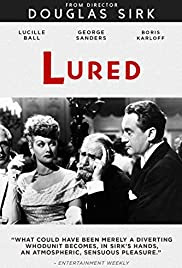
Film review: Lured (1947)

That's Lured with an "e", although it could just as well be Lurid, given that the plot involves a serial killer who sends Baudelaire-inspired poetry to the cops before killing his young female victims.  Not to mention that it's directed by Douglas Sirk, who is the byword for melodrama.  However, this is an early work (and black and white, unlike his lush later pictures), and dials down the torrent of feelings a little.  (It's helped in that regard by being set in England and having George "Sher Kahn" Sanders as a male lead.)  The female lead is Lucille Ball, and if that's an odd pairing to you, consider that this also features Boris Karloff!  I don't normally find Ball's mugging that appealing, but she works well in this picture (and isn't as extreme as in her TV work) as Sandra Carpenter, an American dancer who came over to London with a show and got stranded when it folded in a week.  She's working as a taxi-dancer at the start of the film 

when her best friend vanishes and is assumed to be a victim of the killer poet.  She is pursued by Sanders' Robert Fleming, who is taken by her voice on the phone and wants her to audition to be a dancer at one of his nightclubs (and more than that), while also being recruited by Charles Coburn's Inspector Temple of the Yard to be a Lure to catch the killer.  

(Coburn was the Devil in the Devil and Miss Jones, where he showed his comedic chops, while here he gets to try out a (moderately successful) English accent and serious acting as a patrician but dogged head cop.)  Karloff shows up as a false alarm: he's a mad old dress designer who recruits our heroine to model his dresses in front of an imagined audience and snaps and threatens her with a sword.  

(This is played mostly for laughs: this film switches tones on a dime - obviously the basic plot is pretty upsetting, and there are some very tense moments, but any film with Ball in it is going to have some laughs, and it becomes a pretty straight-ahead romance (Sirk's wheelhouse) towards the end.)  After a side plot where Sandra works as a maid in a house where the butler recruits young women to be sold off to South America, 

Robert saves Sandra and and in short order they are engaged to be married, 

but she finds her friend's bracelet (mentioned in the poem sent by the killer before she disappeared) in Robert's desk drawer, and Temple arrests him.  All signs point to his guilt, but Temple is unconvinced and instead focuses on his best friend and business partner (who lives in his house) Julian, who happens to have Baudelaire on his bookshelf.  But then Robert confesses!  And a distraught Sandra turns to Julian for comfort!  How will it end?  Well, it's worth watching to find out.

Monday, August 10, 2020

Film review: Long Weekend (1978)

The Criterion Channel has just added a collection of Australian New Wave films, of which this is one, and it seemed of a piece with The Birds, so I thought we'd give it a shot.  I regret it.  Not terribly, but it isn't as good as it's made out to be.  Mind you, if I'd seen it late on a Friday night on Channel 4 in the early '80s, it probably would've made a huge impression on me (like similarly dubious spooky films like She Waits or  The Shadow of Chikara did).  But as it is, I feel it wasted a good premise.  It could've easily been a one hour episode of something like Tales of the Unexpected or Hammer House of Horror with a title like "The Dugong".  Here's the basics: the main couple (who comprise the entire cast for more than 95% of the film) head off for a camping trip at his behest.  She'd much rather be going off with the neighbor couple, with whom, it emerges, they'd been engaging in some partner-swapping, initially (she says) at his suggestion because he fancied the wife, but he got jealous when she got it on with the husband.  There's also been a recent abortion, and their sex life has been floundering.  So this is his attempt to bring them together.  But, let's be honest, apart from the fact that they deserve each other, as neither is remotely likable, they should not be together, because they have nothing in common.  Well, except both of them seem to have a contempt for the outdoors, which she manifests by staying in the tent reading trashy novels, and he by going out and shooting things and spreading litter.  But let's backtrack: things get off to a bad start when he runs over a kangaroo (in very realistic and upsetting detail).  Then they stop off at the Aussie equivalent of the beaten up, shitkicker-staffed general store that is at the beginning of every backwoods horror film, where the locals surprise our hero by not having heard of the beach that he thinks is just 5 miles down the road.  They say nobody goes that way any more, and proceed to gawp at the couple's off-road vehicle as it drives off, as if to say that that's the last they'll see of them.  Then they struggle to find the beach - they drive down an overgrown track but it gets dark, there are strange animal cries all around, they get a puncture and they keep passing what looks like the same tree.  So they end up sleeping in their car.  It turns out the next day that they are just yards from the beach, and it is indeed a beauty, and for a brief moment, they stop bickering.  

But it doesn't last long, and things keep going wrong.  He goes surfing, she sees a black shape in the water near him.  He shoots it from the shore.  

Later it washes ashore, and it's a dugong, and he thinks some of the more chilling animal cries are its offspring calling for its mother.  Then he gets attacked by an eagle (in a moment that isn't any better realized than the bird attacks in The Birds) which she attributes to her having picked up its egg, so she breaks it (and it's all bloody).  

Bizarrely, given all the shooting he's been doing, he objects, and this leads back to the abortion. Later he notices that about a mile down the beach there's another camper van, and after they have bickered enough and been freaked out enough to decide to leave, he insists they visit their fellow campers first.  But when they get there, the van is gone, except there's something in the surf that looks like the top of a van.  He finds a dog in a tent in a strangely overgrown campsite then returns to find her walking into the surf, apparently driven crazy by strange animal cries.  

He pulls her back then swims out to the thing in the surf, and finds that, not only is it the van, but the driver's still in it.  Oh, and I've skipped over the strange mold that grows on their defrosted chicken (or "chuck") and a disfigured Barbie doll he finds on the beach.  

They return to their campsite to finish packing up but somehow manage to argue so much that she leave him behind and drives off.  Meanwhile the corpse of the dugong somehow manages to keep moving closer...  

Will they get out alive?  SPOILER: I'll tell you at the end.  Lots of animals certainly don't, although, perhaps surprisingly, his old dog Cricket (another thing about him she seems to hate) survives.  (This is very important, as evidenced by the existence of the website Does The Dog Die.)  What is the message of the film?  Well the message I took was that Australians can be really obnoxious, but there's clearly some kind of pro-ecology point, although it's not as if they do really serious polluting (despite her liberal use of the ant spray).  Don't shoot dugongs, I guess, which is a message I can certainly get behind.  As a film it certainly has some strengths, and as I said, if it had been an hour episode of a horror anthology (something it looks well-suited to, because it's seriously micro-budget) it would have impressed the hell out of adolescent me.  But the dialogue is clunky and I really did very quickly want both of them to die. Did they?  Well, here's the spoiler: yes.  He shoots her with a spear gun by accident, as she crashes the car trying to escape and mistakenly runs back to the campsite where he's sitting, terrified.  

Then he runs to the road and sees a truck, whose driver is attacked by a bird (the eagle again?) so he doesn't see him and squashes him flat.  This is, I regret to say, the point at which both Jami and I LOL'd in unison.  But Cricket, like the dog they found in the abandoned tent, should be fine. (Here are two good contrasting reviews of the film: positive, and correct.)

Sunday, August 9, 2020

Film review: The Birds (1963)

 There are quite few Hitchcocks I've not yet seen, and it's usually by choice (Marnie, Torn Curtain, Topaz, Family Plot, all but one of the silents) but this was an odd gap in my viewing - until now!  Verdict: effectively tense despite occasional unintentionally funny moments, not all of which are because of bad bird FX.  I expected to hate Tippi Hedren, but I actually thought she was very good and carries the movie well, despite being shoehorned into Hitchcock's usual blonde ice-vixen box.  Sure, she's an ice-vixen, but she makes it work.  And one good thing about her performance is that she never screams, despite ample opportunity.  Rod Taylor I'm not so sure about.  He's serviceable, but he looks distractingly as if someone took Robin Williams and shot a handsomizer ray at him.  (A quick Google reveals that I am not the only one to whom this occurred.)

But what's sort of interesting is that he's essentially only the major male role, surrounded by women.  (Even the best supporting character is this old, well, bird, who is an ornithology expert ready to poo-poo tales of bird attacks and present the birds as more sinned against by man than sinning [the basis for the "Eco-parable" interpretation of the film]) 

There are interpretations of this film that make him the central figure and the birds the allegory of the torrent of female feelings swirling around him, but he doesn't really do much to warrant being the Sun in this little solar system.  Indeed, the whole beginning premise of the film is Tippi Hedren's Melanie Daniels driving all the way up to Bodega Bay from her home in San Francisco just to "play a joke" on Taylor's Mitch Brenner.  This is putatively because she's angry at him for tricking her, but clearly she's got a crush on him, despite being a wild rich socialite to his humble lawyer.  They meet in the beginning scene of the film in a pet store - she's asked the owner to make a call in the back for her and he comes in asking for a pair of lovebirds for his (11-year-old - it's never explained why there's such an age difference, as he looks at least 30 ish) sister and appears to mistake her for the sales assistant.  She plays along, while clearly demonstrating her lack of knowledge about the birds for sale, until he replaces an escaped canary in its cage saying "Back in your gilded cage, Melanie Daniels", thereby revealing that he knew who she was all along.  He claims he did so because he watched her use her influence (her father is part-owner of a major newspaper) to get out of something in court and was offended.  Anyway, he swears he really did want the lovebirds, but leaves without them.  So she orders a pair and intends to leave them outside his apartment (she finds his address through her connections at the paper) with a nasty note, but his neighbor reveals that he's gone home to Bodega Bay for the weekend, and the birds won't survive.  So off she goes in her fancy little sports car.  There's very little hint of the carnage to come until she is attacked by a seagull, getting out of the boat she's used to steal across the bay to deliver the birds to his house (which is across the bay from the town).  

He's seen her, though, and has driven to town to wait for her, so he sees the attack.  (We find out later that this is not the very first attack - seagulls attacked a fishing boat earlier in the week.)  Anyway, she's already met Suzanne Pleshette (most famous for being Bob Newhart's wife in his first eponymous sitcom), who is the town schoolteacher, and decides to stay with her after Mitch invites her to dinner that night (to the evident consternation of his mother, Jessica Tandy (looking very young and beautiful, well, compared to how I think of her).  Turns out Suzanne Pleshette's Ann moved to Bodega Bay following Mitch, but it didn't last, perhaps because of the mother, although they are now friends.  This is the basis for the psychosexual interpretation, a rare plausible suggestion by Camille Paglia, according to which the bird attacks happen when Melanie intrudes on Mitch's mother's control of her son.  Another advantage of this interpretation is that it makes sense of an otherwise infuriating episode where, after sheltering in their boarded-up house and surviving a concerted bird attack, Melanie wakes up to hear fluttering upstairs and, without waking anyone else up, goes upstairs and opens a door.  The room is of course full of birds and she is almost killed.  FOR NO REASON.  

But according to this interpretation, she "sacrifices herself" to break the curse that has begun when she arrived in town (except, of course, the fishing boat episode shows that it didn't).  Anyway, is it a good horror film?  Well, it does take a long time to get going with the attacks, but I'm okay with that.  Most good horror films take a long time establishing mood before they start the bloodbath.  And, while some of the bird FX are, frankly, laughable, I do find the idea of being attacked by gulls genuinely plausible and horrifying - they could obviously do real damage.  And the best scare in the film is when Jessica Tandy goes over to a neighbor's house (whose chickens, like hers, have been suspiciously off their feed) and, when he doesn't answer the door, goes into his house.  The first thing she notes is that every cup hanging on his kitchen dresser has been broken.  Tension mounts as she tiptoes down the hall until she finds him... dead - with his eyes plucked out.  

The camera zooms in on this grisly effect, which must have been about as gory as it gets for 1963.  And of course, there's the iconic scene where Melanie arrives to pick up the 11-year-old from the school and is sitting outside with her back to the climbing frame as, unseen by her, it fills up with birds. 

A moment that wasn't so effective is when everyone is sheltering in the downtown restaurant watching havoc unfold outside (a man is filling his car when he's attacked and the petrol runs to another car where a man drops his lit cigar and is enveloped in a fireball) and we see three quick stills of Hedren looking in three different directions with a variety of appalled expressions.  For some reason it looks ludicrous, which I'm sure was not the intended effect.  But you're not laughing any more when they find Suzanne Pleshette's body, brought down on her own doorstep.  That's what you get for flying too close to the Rod Taylor Sun.  I'm not sure how I feel about the ending.  In one way it's good because it doesn't try to tie up loose ends - it's like the original ending for Invasion of the Body Snatchers, before it was softened.  But on the other, it's unsatisfying.  Nowadays it would be a sign that a franchise was starting and there would be successively more disappointing sequels.


Saturday, August 8, 2020

Film review: The Squeaker (1937)

AKA: Murder on Diamond Row:

Watching this made me appreciate Hitchcock more.  It's a British thriller, set in London, featuring Robert Newton 

(as a sort-of bad guy who we root for because he's trying to leave his life of crime and set up with the beautiful [at least, I think we're supposed to think so] Teutonic nightclub singer Tamara) 

and Alastair Sim (already looking old at 37, and chewing the scenery as a comic Scottish reporter), but neither is the lead good guy (a Canadian called Edmund Lowe) or bad guy.  The "Squeaker" is a mysterious figure who buys jewels off jewel thieves but will shop them to the police if they displease him (i.e., he "squeaks" - presumably the British pre-war equivalent of squealing).  Meanwhile he is mastermind of organized crime in London (allegedly).  The cops can't catch him, but in looking over a lineup of suspects in the latest jewel robbery, the chief inspector spies an ex-detective of his (Lowe), clearly down on his luck (much is made of his disreputable stubble).  Turns out alcohol has been his downfall since last he worked for the Yard.  The chief inspector gives him a chance to prove he can stay clean and recruits him to catch the squealer.  He quickly latches on to the idea that the Squeaker would be likely to employ ex-cons (on whom he has dirt and can thus squeal) and gets Sim's character to suggest a name.  This turns out to be Frank Sutton, a business big-shot whose girlfriend is the daughter of the founder of the company.  This daughter (Ann Todd, whose diction could cut glass - she's practically a caricature of a BBC announcer) quickly falls for our hero (once he's shaved off that stubble).  

Meanwhile, the Squeaker squeaks on Robert Newton's character and the cops get him, but he makes a daring escape from the Yard and, after visiting Tamara one last time, goes to take revenge on the Squeaker.  But he gets shot!  And Sutton blames our hero, not knowing that he's an undercover cop!  This all leads up to a denouement that is very melodramatic.  Not Korda productions' finest hour, I have to say.