Saturday, November 2, 2019

Film review: Shadow of the Vampire (2000)

This should have been great.  An interesting premise (based on a real myth (not an oxymoron)) - that the actor who played the original Nosferatu, Max Schreck, was in fact a real vampire - a great cast (John Malkovich! Willem Dafoe!  Eddie Izzard! Cary Elwes!), and for the first half or so it definitely had potential.  But Malkovich is strangely disappointing (rather one-note) and once Eddie Izzard disappears about halfway (presumably he's killed by the vampire, as so many of the film crew are), the film goes rather dreary (although Cary Elwes, who is a replacement cameraman to take over for Schreck's first victim, does his best to elevate matters).  The trouble is, I don't think they decided on what it was.  Occasionally that's okay - films like American Werewolf in London manage to switch gears smoothly and be successfully scary, romantic, funny and then tragic, but this one doesn't pull it off.  Part of it is that Malkovich's Murnau (the director) is both opaque and unlikable.  He sacrifices the lives of his crew and in particular, his star actress, to capture "Schreck" (who is actually Count Orlock, the name of the vampire in Nosferatu, on celluloid.  To be fair, it looks like he had a plan to avoid giving up Greta (it involved a big chain-operated sliding door that would let the daylight in to destroy Orlock before he got to chomp down on Greta), but Orlock outwitted him and sabotaged it, so in the end, just about everybody except Murnau ends up dead.  And Murnau just doesn't seem that bothered.  So is it worth watching?  Well, Eddie Izzard is fun, but it's almost impossible to watch him and not be reminded of bits from his standup.  But mainly Willem Dafoe is amazing (as always) as Schreck.  So if you're a Dafoe-head (which is a thing I just invented), you have to see it.


Friday, November 1, 2019

Film review: Fiend Without a Face (1958)

It being Halloween, we decided to watch a horror film.  But nothing too horrific now we're old and pathetic, so let's see what the Criterion Channel has to offer.  Not much, as it happens, at least that we haven't seen.  So we selected this little offering.  Let's just say that I've seen higher quality films.  It's not that it's an Ed Wood level turkey - the acting is fine and when you finally see the monsters, there're some fun stop motion effects:
...but the plot is just silly on a level that is hard to get past.  Basically, the action is set on an American air base in the middle of nowhere, Canada.  They've got a kind of experimental super-radar that involves communicating between jets flying overhead and the control room, and that is powered by their own personal atomic reactor.  But something seems to be draining the energy from it just as they extend the scanning range to spy on the Russkies.  And at the same time, innocent townspeople keep getting killed by an invisible attacker that chokes them and (autopsies reveal) suck out not just their brains, but their entire spinal columns, somehow through little vampire bites on their neck.  Where do these invisible monsters come from, you ask?  Well you'll wish you hadn't. You'd think, this being an air base, and this being the UFO-obsessed 50s, it would be aliens.  But NOOO.  Instead, the answer is that an eccentric genius professor (that's him, above) has discovered how to do telepathy with a LOT of electricity, and the result was that the power of his mind turned into the kind of things that hold thoughts - you know: brains.  Why are they invisible?  Don't ask me.  Why can we eventually see them?  Because they get more power from the reactor.  Are they made of the brains and spinal columns of the dead people?  Unclear.  That would make sense, wouldn't it.  So it's probably wrong, especially as this is a film where they shut down a nuclear reactor that has had all its rods destroyed by BLOWING IT UP WITH DYNAMITE.  It's very, very silly.  Just look at the gifs above and you've seen all you need to see, really.  Well, except for this (as promised in the poster):


Wednesday, October 30, 2019

Fillm review: Baby Face (1933)

This is the third of the "pre-code" Barbara Stanwyck films on the Criterion Channel that we've watched, and while it's probably last in "pure entertainment" value, it's probably the most culturally interesting.  In all of them Stanwyck plays a similar brassy, mouthy modern young woman, ready to take care of herself, but this film's Lily is certainly the most ruthless of her three roles, and from the worst background.  We are introduced to her in her father's speakeasy, where he tries to prostitute her out to a local politician so that he will continue to turn a blind eye to the illegal hooch-sales.  And we discover that this is far from the first time he's done this, in fact he's been doing it since she hit 14.  But this time she smashes a bottle over the politician's head (after first scalding his hand with hot coffee),
perhaps influenced by the words of advice of the Nietzsche-loving (no, really) old German cobbler, who advises her that she should get out and use her feminine power to get ahead.

Things are brought to a head that very night when the father's still blows up, taking him with it.  She and the other speakeasy employee, "Chico" (who continually sings St. Louis Blues, to the occasional annoyance of those around her) hop a freight to New York (from Erie) but are discovered and threatened with jail.  However Lily employs her seduction techniques for the first time for her own benefit (following Nietzsche's advice), while the screen discreetly fades to black.  Next we see Lily and Chico walking between skyscrapers complaining about hunger, until Lily decides that one of them, a big bank building is the right one, and goes in to apply for a job.  Many others have left disappointed, but weren't as ruthless as Lily, and her second "conquest" is the chubby male secretary who's been turning the others away.  From then on she works her way up the food chain (starting with a very young John Wayne)
often getting men fired on purpose while feigning innocence herself.  Her second-to-last stepping stone in the fiance of the boss's daughter, whom she ensures sees them smooching.  This gets the boss involved and in no time he's got her set up in a love nest, dripping in furs, with Chico as her maid (now annoying the Boss with her singing).  However, the smitten not-son-in-law tracks her down and tragedy strikes as he shoots the boss and then himself.  The remaining bank board meets both to appoint the playboy grandson of the founder as the new boss and to decide what to do with Lily, who is threatening to sell her story to the papers for 10 grand.  She thinks she's conned them into paying 15 grand for it when the unexpectedly savvy playboy pretends to buy her. sob story (about just wanting to live her life and support herself) and proposes to ship her to their Paris branch under a new name.  She shocks him by actually succeeding and running the travel bureau of the branch amazingly well.  But of course he falls for her, and even marries her, but then the bank crashes!  And he's indicted!  And he asks for all the gifts he's given her (including her suitcase of half-a-million in bonds) to bail him out.  But she can't shed her Nietzschean ethos and instead splits to sail back to Paris (they'd been called back to NY by the panicked board).  But then change of heart!  But he's shot himself, broken-hearted!  Is that the end?  Watch it and see.  So what's the message?  Life's tough for dame from the wrong side of the tracks?  Nietzsche will get you what you think you want but then you won't be happy?  Either way, Stanwyck is good as always, and despite not being conventionally attractive, can play a convincing heartbreaker:
I wouldn't be surprised if this was the flick that convinced Billy Wilder to cast her in Double Indemnity.


Saturday, October 26, 2019

Film review: Dolemite Is My Name (2019)

Want to see a heartwarming feel-good story that also features a better-than-he's-been-in-decades Eddie Murphy saying "motherfucker" practically every other word?  This film's for you!  It's a biopic about Rudy Ray Moore, a failed R'n'B singer who tried his hand at stand up comedy in the early '70s and perfected a persona of an eloquent pimp (Dolemite) who told Rabelaisian tall tales in rhyming couplets.  At every stage he faced skepticism and had to go it alone until his success became so apparent that financial backers stepped forward.  For example, he taped a "party record" (like Redd Foxx's very popular (and also obscene) lps) but no record company would release it until he (on money borrowed from his aunt - my favorite scene in the movie) financed his own pressing and started selling it out of the trunk of his car.  Then he goes on tour and recruits a plump female protege whom he sees knocking down her unfaithful husband in the back of a club he's performing in, adding to the amiable entourage he already has.  (Familiar faces in this film include Snoop Dogg, Keegan-Michael Key, Craig Robinson, Chris Rock and, playing definitely against type as a camp drunk actor/director, Wesley Snipes.)  He is called back when the record company that eventually signed him (they're run by what I took to be an Arab family, so neither in the white nor the black world) want him to record more records, as the first one is wildly successful.  Then, somewhere along the way, after a bad experience with the Matthau/Lemon version of The Front Page, he decides that there is a market for a movie starring Dolemite.  Of course, he has to do it himself, and recruits Key as an earnest local playwright with a social conscience (a fellow Arkansas refugee) to help structure it, and Snipes as a semi-celebrity (he says he's been "directed by Roman Polanski" because he was an elevator operator in Rosemary's Baby) to lend it gravitas.  Then they get some white kids who are students at UCLA film school to do the filming, and Moore moves into an old abandoned hotel (having first acquired the manager job by turfing out all the junkies as a deal with the owner) which becomes the sets.  Of course nobody wants to buy the finished film, but on a suggestion from an Indianapolis DJ (Rock) he rents a cinema for $500 if he can keep the ticket sales.  It's a huge success, so, again, a movie company (headed by Bob Odenkirk) buys it and the film ends with its LA premiere, with queues snaking round the block.  As I said, a feel-good film.  In fact, if it wasn't for the relentless vulgarity and Murphy's wonderful comic but sincere performance, it might be treacly.

Wednesday, October 23, 2019

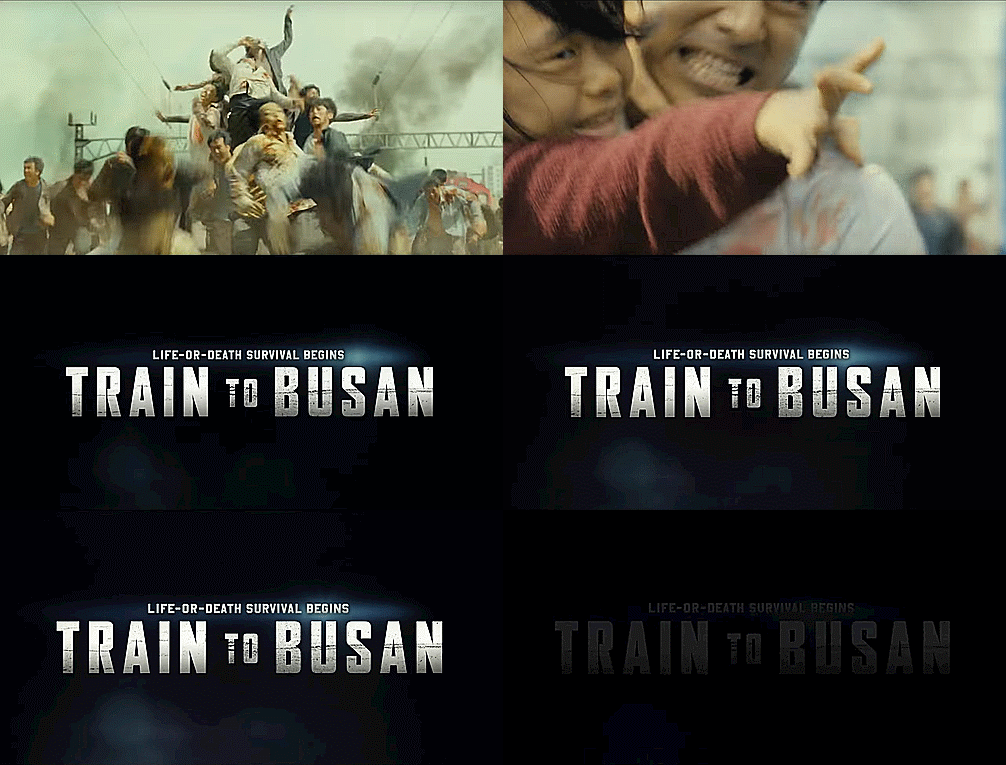
Film review: Train to Busan (2016)

I've been reading about this Korean zombie movie essentially since it came out.  Old as I am, I don't like non-comedic zombie flicks as much as I used to (and have never watched The Walking Dead) just because I don't need a fictional Armageddon when we're staring down the real thing.  Also, there are several very upsetting tropes in zombie films, notably "loved one becomes zombie and either kills you or must be killed" (something Zombieland avoided, and hence I have fonder feelings for it than the superior Shaun of the Dead, that didn't) and "in response to the zombie outbreak, fascistic leaders emerge amongst the survivors" (this is notable in 28 Days Later, and, of course, Day of the Triffids, which 28 Days ripped off in other ways (the opening) too) - i.e. "the real monster is us".  Turns out Train to Busan has both, and is pretty damn upsetting, but has enough fresh ideas and relentless pacing that you forgive it.  Don't get too attached to anybody in this film (except the obvious little girl, but even that's a risk if you've seen the even-more-praised Korean horror film The Host), especially if they give a speech about how sacrifice is needed.  So, the obvious first question for students of the zombie genre (well, all of them have already seen this, but let's pretend) is are these Romero zombies or Russo zombies?  The former, of course, are the canonical shambling, usually stupid (although see "Bub" in Day of the Dead and "Big Daddy" in Land of the Dead) and all-flesh (with a particular fondness for entrails, usually ripped out of their still-living host) consuming, as also featured in Shaun.  The latter, as made clear in a classic Onion piece, are much scarier: they talk (usually just "Braiiinnsss", but occasionally "MORE braiinnsss"), they can run fast, they only eat brains, and, unlike Romero zombies that can be killed by a shot to the head, these are practically unkillable, as you can cut them into bits and all the bits will be alive.  (The apotheosis of this is the zombie intestines in Peter Jackson's Braindead/Dead Alive).  Well, it turns out they're more like Danny Boyle "zombies" a.k.a. "The infected" from 28 Days Later.  These are not obviously zombies (although the remake of Dawn of the Dead was clearly influenced by them) but more like super-rabid humans, but they have a savage hunger for flesh and run like bejesus.  Same in Train to Busan, along with the explicit idea that they are the result of biotechnology, but with the added idea that they are the dead returned to life.  What makes this easier to stomach (pun intended) than some of the Romero films is that the viscera is fairly minimal.  No yanking out of intestines by the fistful or exposed bones or brain-chomping.  There is a fair amount of blood, but not even Penkinpah levels of that, really.  And these zombies are really stupid.  If it goes dark, or they can't see you (in one instance because somebody puts a coat over their head), they forget about you (something that is mined for several set pieces, especially when one group of survivors has to fight through several train cars to rescue another that's trapped in a toilet).  The horror is in their sheer numbers and the speed at which they rush towards any perceived prey.


The basic plot is this: workaholic young fund-manager, who has custody of his young daughter, but is separated from his wife (who lives in the titular South Korean city of Busan), screws up by buying her a Wii for her birthday when he's already got her that present previously.  He asks how he can make up for it, and she says for her to visit her mother on her actual birthday the next day (something he's previously asked her to postpone).  As they board the train something strange is happening in the station, and an infected girl gets on the train and "changes" in the toilet.  Another stowaway is a strange homeless-looking man who just mutters about how everyone is dead, so he's obviously witnessed the carnage they're leaving behind as they pull out of the station.  Well, very quickly the girl bites a stewardess and in no time a whole train car or two is full of ravenous zombies.  Meanwhile our fund manager has pissed off a beefy working-class type who has a pregnant wife to protect by almost locking the couple in with the zombies.  However, as you might expect, beefy and fund manager become friends over the course of the movie (or at least, until the first of them... I've said too much).  What makes this movie great is that it keeps coming up with ideas for new set pieces.  That and the scarily convincing picture it paints of what would very quickly happen to South Korea in just such a situation.  There are several moments, however, when you do think that it would have been so simple to avoid catastrophe (don't put your hand near a zombie's mouth when you're wrestling with one) and there is one particularly loathsome businessman passenger who is responsible for the death of several very sympathetic characters, and he doesn't even get a particularly good comeuppance.  But if the mark of a good film is that it can be around two hours long and you hardly draw breath for most of that, then this has it.  And don't worry, it doesn't do the "pregnant woman's fe(o)tus dies and zombiefies inside her" thing that other, more nihilistic zombie films have before it.  Nor does it mimic the heartbreaking ending of Night of the Living Dead, even though it looks like it's about to.

Sunday, October 20, 2019

Autumnal scenes


Film review: The Body Snatcher (1945)

There are certain actors who became pigeon-holed as "horror" actors, but who always elevate whatever they're in, and in a just world would be more appreciated for their screen presence.  Vincent Price is one, of course, Peter Cushing another, but towering above all must be Boris Karloff.  His performance in the first two Frankensteins is positively heart-breaking, and an off-note could so easily have dissolved them into camp (as followed pretty much immediately he gave up playing The Monster).  And yet he could also play truly sleazy evil, as he does in the (frankly bonkers) The Black Cat, and this one.  
This is another Val Lewton production, but is directed by Robert Wise, who would later go on to direct West Side Story and The Sound of Music!  It's based on a Robert Louis Stevenson story, set in the just-post-Burke and Hare Edinburgh.  In fact, Karloff's character is supposed to have gone on trial at the same time as those two, and covered up for the other main character of this film, Dr. "Toddy" MacFarlane, played suavely and compellingly by Henry Daniell, an actor I'd not heard of previously, but whose work I will now seek out (although I must have seen him play Moriarty to Basil Rathbone's Holmes when BBC2 used to run those old films on Thursday nights).  MacFarlane runs a school attended by our putative protagonist (who sounds like the lone American of the cast, even though he wears a tam o'shanter and seems to be attempting a brogue) Donald Fettes, who alternates between quitting the school in disgust because it relies on corpses provided nefariously by Karloff's slimy Gray, and helping acquire them (he's not got the stiffest of spines, ironically, seeing as spine surgery on an adorable little girl with a pretty young mother is a subplot).  This one has the usual great Lewton extreme shadows, and Karloff is wonderfully sinister and Daniells appropriately tortured by the hooks that Gray has in him, and there are a couple of outright shocking moments (including the freshly killed corpse of Bela Lugosi (yes, he's in it too, just like The Black Cat, only in a very small role and looking very old) floating up to the surface in a big vat of water) as well as Karloff killing a cute little dog with a shovel) but it's not a first-rank Lewton (no shame in that - that's a very high bar), although the ending is a bit of a corker.

Saturday, October 19, 2019

Film review: House on Haunted Hill (1959)

Jami spotted this on a list of black and white horror movies, almost all the others of which we'd already seen, so...  Is it good?  Well, sort of.  Imagine Agatha Christie crossed with Scooby-Doo and you should get the basic idea.  Vincent Price is good, as always, and it's got the squirty little guy from Maltese Falcon (Elisha Cook Jr.) as an alcoholic who believes all the stories about the house and keeps uttering doom-laden comments like "They'll come for us, they won't stop" which makes you wonder why he is among the seven who accepted an offer of $10,000 from eccentric millionaire Frederick Loren (Price) to stay the night in a strange-looking (in fact designed by Frank Lloyd Wright and near where we used to live in LA) house. They arrive in hearses commissioned by Loren - three men, the little lush who owned the house and knows its disturbing history (seven people murdered in nasty ways), a psychiatrist (whom Loren's voice-over tells us betrays his greed "about his mouth and eyes") and a jet pilot, and two women (the young Nora Manning, who is part of Loren's company but has never met him, and who receives the bulk of the scares, and the gossip columnist/gambler, who keeps getting blood dripped on her from above.  Loren is there to see them arrive and watches quietly from a landing to see Nora almost killed by a falling chandelier.  He then strolls off to a bedroom where his glamorous and much-younger (4th) wife is waiting.  They banter about how this is a party and that it's for her, but very quickly it emerges that not only can they not stand each other but that he thinks she's already tried to poison him.  She refuses to join the party, so he goes down to meet the guests.  The little guy shows them the house, including the room with the ceiling blood-patch (a little girl), the knife in the draw (that was used to cut up two family members, whose heads were never found) and, best of all, the giant tank of lethal acid under a hatch in the floor of the basement.  (Apparently this was used for wine-making, but as the guy demonstrates with a rat, if you throw in something with "flesh and hair," all that floats to the top is a skeleton.)  Almost immediately Nora and the Pilot have problems in the basement after the others have gone back upstairs.  He goes into a dark closet and gets knocked out, she sees (in one of the scariest scenes in the film) what she is sure is the ghost of an old woman.  Turns out both of those things were caused by the old caretaker couple (in true Scooby-Doo fashion) who are supposed to hang around until midnight before locking the party in for the night, but scarper early, thus not allowing the already-spooked Nora to forego her shot at her ten grand.  To spice things up, Loren then passes out "party favors" - little coffins that reveal pistols on opening.  Everyone takes one, even the little guy who insists they won't save the 7 humans from the 7 ghosts, except for Loren's wife, who has been "encouraged" to join the party.  Loren replaces her gun in the coffin and closes it.  This is significant.
And so the night begins in earnest.  Someone hangs themself/is hanged - or are they?  Someone is shot - or is he?  Two people end up in the vat of acid.  Ghosts appear at windows.  Hands reach round doorways and grab shoulders.  Double-crossers are double-crossed.  There's a malevolent, talking skeleton (cue Emergo!) But five people survive the night, much to the apparent disappointment of the perpetually gloomy little alcoholic.  Should this have been on a list of great black and white horror films?  Not really - it's a diverting little number, and the best film directed by famous schlockmeister William Castle, but I don't think it would scare anyone older than about 11.  But Vincent Price never disappoints.